A camera can watch you move, but it needs line of sight, space and decent light. A tiny inertial sensor — the accelerometer-and-gyroscope chip that sits in every phone — has none of those needs: it's cheap, it fits anywhere, and it samples motion a hundred times a second. The catch is turning its raw readings into an actual path. You have to integrate noisy acceleration twice, and the tiniest bias snowballs into metres of error within seconds.
This was my final-year engineering project (projet de fin d'études) at CEA LIST, in the LISA lab for sensory and ambient interfaces, supervised by Pierre-Henri Orefice and Mehdi Boukallel. The brief was deliberately narrow: not a general motion tracker, but the 3D trajectory of one simple, repeated hand gesture — the kind you'd study in sport or rehabilitation — recovered from a single BNO055 IMU, using deep learning to swallow the sensor biases that classical methods have to model by hand.
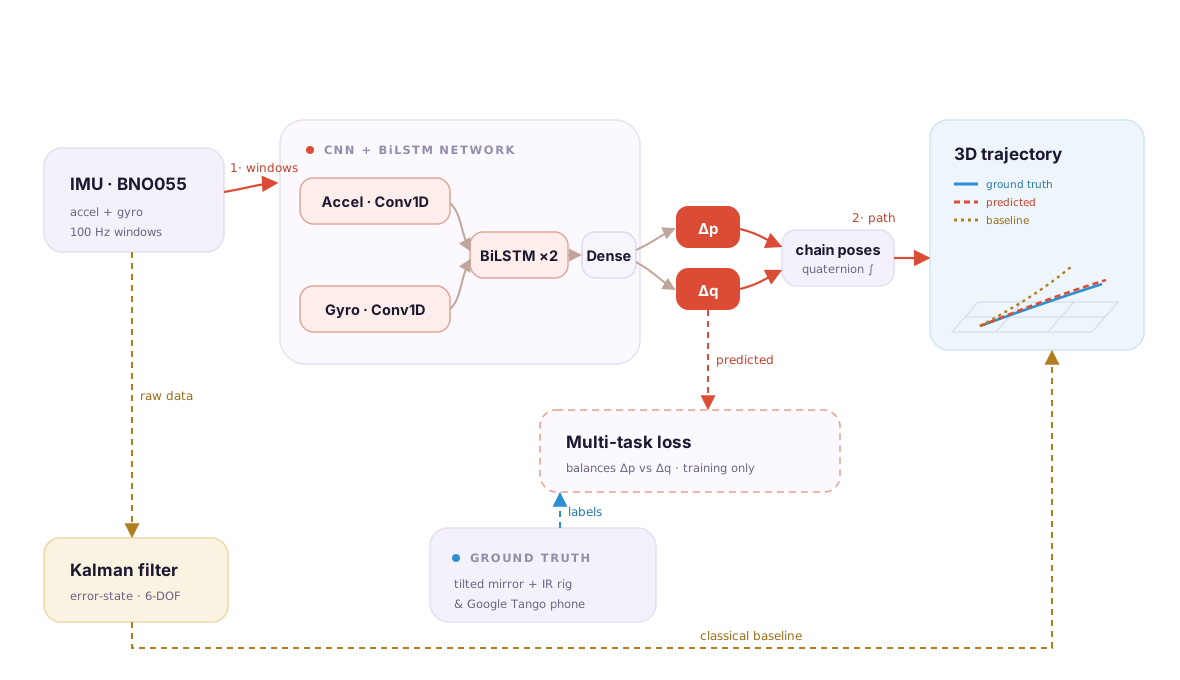
I built two systems side by side. A classical baseline first — an error-state Kalman filter over the full six-degree-of-freedom kinematics — so I'd know what 'good' looked like. Then the deep-learning model: it takes short windows of raw acceleration and angular velocity and predicts the change in position and orientation between two instants; chain those small deltas with quaternion math and a trajectory falls out. Two convolutional branches read the accelerometer and gyroscope separately, a bidirectional LSTM ties the sequence together, and — the part I'm proudest of — a learned multi-task loss automatically balances the position error (in metres) against the orientation error (unit-less), so neither term drowns the other during training.
The hard, unglamorous part was ground truth: you can't train a model without knowing the real path. With no motion-capture lab — and then a COVID lockdown — I built my own rig at home. The sensor slid down an inclined mirror past three infrared distance sensors wired to an Arduino and a Raspberry Pi, which gave an exact reference path from basic physics. After lockdown I strapped the IMU to a Google Tango phone, whose visual-inertial tracking is accurate to a few centimetres, and time-aligned the two devices by cross-correlating their motion. The verdict was honest: orientation was predicted almost perfectly, but position is genuinely hard — accurate over short, mostly-1D motions and drifting on longer 2D ones. That limit of inertial-only odometry was exactly what the project set out to measure.