portfolioprojects
paris, fr
← all projects
DOCTORAL RESEARCH · LaBRI · UNIV. BORDEAUX / CNRSPhD · 2023

Reading disease in a single brain scan

My PhD — a new generation of deep-learning biomarkers that detect neurological disease from a structural brain MRI, built to be accurate, to generalize across scanners, and to stay understandable for clinicians. Four studies, shipped as four registered software tools on the volBrain platform.

degree
PhD · Computer Science
lab
LaBRI · Univ. Bordeaux
advisor
Pierrick Coupé
defended
Nov 2023
deployed
volBrain · 4 tools
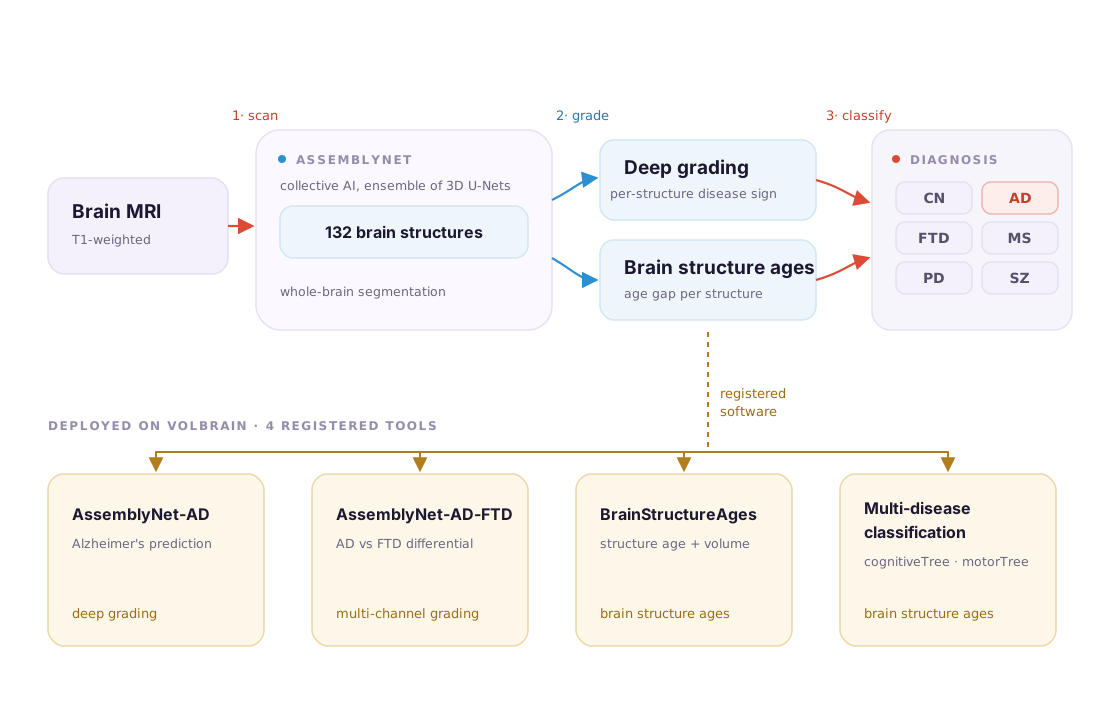
Flow diagram: a T1-weighted brain MRI is segmented into roughly 132 structures by AssemblyNet, an ensemble of 3D U-Nets; two interpretable biomarkers — deep grading and brain structure ages — are computed and used to classify cognitively normal, Alzheimer's, frontotemporal dementia, multiple sclerosis, Parkinson's and schizophrenia; the methods are deployed as four registered tools on volBrain: AssemblyNet-AD, AssemblyNet-AD-FTD, BrainStructureAges and a multi-disease classification service.
The pipeline — a single T1-weighted MRI is segmented into ~132 structures by AssemblyNet (an ensemble of 3D U-Nets), two interpretable biomarkers (deep grading and brain structure ages) are read off each structure, and a classifier separates cognitively normal from Alzheimer's, FTD, MS, Parkinson's and schizophrenia. All four methods are deployed as registered tools on the volBrain platform.
01OVERVIEW

Brain MRI is now produced at a scale no radiologist can read by hand, and deep learning promised to help — but the early methods had four problems I set out to fix. They often lost to older, simpler machine-learning methods; they didn't hold up on scans from hospitals they hadn't seen; they were black boxes a doctor couldn't interrogate; and each one only knew a single disease. My PhD, at the LaBRI in Bordeaux, was about building a generation of methods that are accurate, that generalize, that a clinician can understand, and that handle many diseases at once.

The common thread is to not predict a label out of thin air, but to build interpretable biomarkers on top of a full map of the brain. Every scan is first segmented into around 132 anatomical structures by AssemblyNet — a 'collective AI' of many 3D U-Nets that vote together — and the diagnosis is then read off those structures, so every answer can be traced back to where in the brain it came from.

The work moved in four steps. First, a biomarker called deep grading for accurate Alzheimer's diagnosis and prognosis. Second, a multi-channel version that tells apart cognitively normal people, Alzheimer's and frontotemporal dementia — a genuine differential diagnosis. Third, a new biomarker, brain structure ages, that scales to many pathologies at once and stays interpretable, demonstrated across Alzheimer's, FTD, multiple sclerosis, Parkinson's and schizophrenia. Fourth, a head-to-head study of CNNs versus transformers for multi-disease diagnosis, compared on generalization and on how understandable each model is.

All of it was integrated into volBrain — a free online brain-volumetry platform used by researchers worldwide — as four registered (legally protected) software tools, so the methods are something people actually run on their own data rather than a result that stops at the paper.
02WHAT I BUILT
01

Deep grading for Alzheimer's — AssemblyNet-AD

A biomarker that assigns each brain structure a disease 'grade' from a U-Net ensemble, giving accurate, interpretable and more generalizable Alzheimer's diagnosis and prognosis. Deployed on volBrain as AssemblyNet-AD.

02

Differential diagnosis AD vs FTD — AssemblyNet-AD-FTD

A multi-channel deep grading that separates cognitively normal, Alzheimer's and frontotemporal dementia at once — moving from detecting one disease to telling confusable ones apart. Deployed as AssemblyNet-AD-FTD.

03

Brain structure ages — many diseases at once

A new biomarker that estimates an 'age' for each brain structure and reads disease from the gaps, scaling to many pathologies while staying interpretable. Proven on CN, AD, FTD, MS, Parkinson's and schizophrenia, and deployed as BrainStructureAges and the multi-disease classification service.

04

CNNs vs transformers for multi-disease diagnosis

A controlled comparison of convolutional and transformer architectures for diagnosing several diseases at once, judged not just on accuracy but on generalization to unseen data and on how understandable each model is.

05

Shipped to volBrain — four registered tools

Every method was integrated into volBrain, the open online brain-volumetry platform, as four registered (legally protected) software programs — so clinicians and researchers worldwide can run them on their own MRI without any setup.

03STACK

Method

deep gradingbrain structure agesAssemblyNet3D U-Net ensembleCNN vs transformer

Domain

structural MRIAlzheimer'sFTDMS · PD · SZdifferential diagnosis

Deployed · volBrain

AssemblyNet-ADAssemblyNet-AD-FTDBrainStructureAgesmulti-disease classification

Tooling

PyTorchPython
04REFERENCES