Custom ReAct reasoning framework
A generic Reason → Act → Observe loop built on pydantic-ai, with visible reasoning steps and iterative refinement until the task is solved. It's LLM-agnostic and reused as a standalone library across the monorepo.
A multi-user Telegram assistant built as a modular monorepo — a custom ReAct reasoning loop calls calendar, weather and notes through three standalone MCP servers, with voice input and long-term memory.
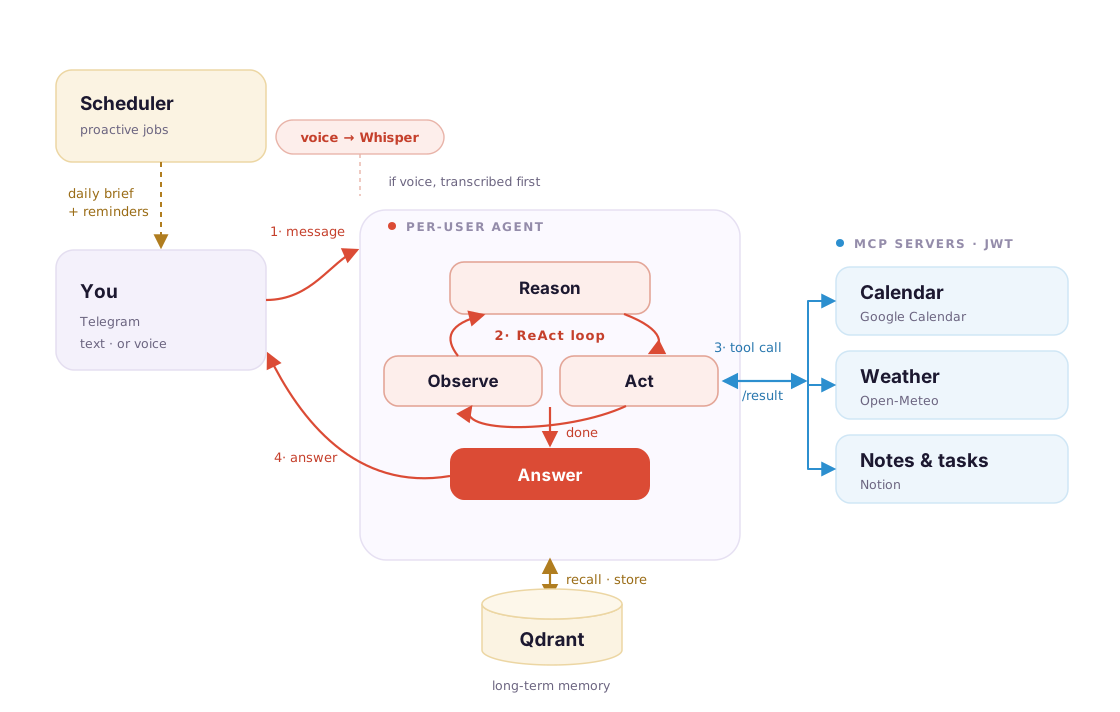
The idea is a personal assistant you simply talk to in Telegram — by text or by voice — that can actually do things: check your calendar, the weather and your notes, and remember you from one conversation to the next. Every user gets their own isolated agent, with its own history, settings and memory.
Rather than one large program, it's a monorepo of small, independent services. A reasoning framework I wrote — a ReAct loop built on pydantic-ai — lets the agent think step by step: reason about the request, pick a tool, read the result, and repeat until it can answer. The tools themselves live in three standalone MCP (Model Context Protocol) servers — calendar, weather and notes — each its own HTTP service, secured between services with JWT, and deployable on its own.
Voice messages are transcribed with OpenAI Whisper; long-term memory is stored as vectors in a Qdrant database so the bot can recall earlier context and answer in a personalised way; and a scheduler pushes proactive messages like a daily weather brief. A shared core library handles structured logging, auth and health checks, and everything is containerised so it can run under Docker Compose or Kubernetes.
I built all of this by hand in 2025 — the reasoning loop, the tool servers, the memory and the scheduling — directly on raw MCP, before self-hosted agent frameworks like OpenClaw packaged the same pattern: a personal assistant wired to your own calendar, notes and messaging that remembers you and acts on a schedule.
A generic Reason → Act → Observe loop built on pydantic-ai, with visible reasoning steps and iterative refinement until the task is solved. It's LLM-agnostic and reused as a standalone library across the monorepo.
Calendar (Google Calendar with role-based access), weather (Open-Meteo, no API key) and notes & tasks (Notion-backed). Each is an independent, JWT-secured HTTP service that can be deployed and scaled on its own.
Per-user agent instances with separate conversation history and settings, plus optional long-term semantic memory in Qdrant so responses stay grounded in what the user told the bot earlier.
Whisper voice transcription, a scheduler for proactive notifications, and a shared core library (logging, JWT auth, health probes). Packaged as a uv workspace monorepo, fully containerised with Docker.